A little orientation
Look closely at a Girard Estate home
Identify the actual house.
A neighborhood history cannot establish an individual home’s layout, materials or repair needs; begin with the address and available records.
Check before changing the exterior.
Look up historic status and consult the City’s current guidance before commissioning work that could affect a designated property.
Ask about shared responsibilities.
For a home with adjoining or shared areas, confirm access and upkeep arrangements with the owner instead of assuming the boundary.
A closer look
Character, care and a place outside
Keep the house-specific questions separate from the guide’s broader account of the estate.
Look beyond a house-type label.
Review the property address in Atlas and bring your questions to a viewing. Ask about the layout, outdoor access and recent work, treating the guide’s twin-house discussion as context rather than proof of what this particular building contains.
A useful questionWhat do the records and viewing tell you about this specific house?
Source & next step ↗Check the rules for the address.
If you are considering windows, masonry or other exterior work, start with the address’s historic status and the City’s approval guidance. Ask the Historical Commission about unclear requirements before commissioning work; the neighborhood name alone does not settle the process.
A useful questionWhat should be confirmed before changing the exterior of this particular property?
Source & next step ↗Choose a visit that suits you.
Look up the guide’s Girard Park reference through official facility information and confirm the access or activity that matters to you. Add the journey from the actual home so the park becomes a practical part of your comparison.
A useful questionHow would you use the park, and what access details need checking?
Source & next step ↗Girard Estate stands out immediately because it breaks many of the assumptions people have about South Philadelphia. The streets feel wider, the homes feel more open, and the neighborhood carries a quieter energy that residents fiercely protect. At the same time, locals are quick to remind outsiders that it is still Philly, with all the complexity, block-by-block differences, parking frustrations, and deeply rooted neighborhood identity that comes with it.
This guide was built from hyper-local patterns, recurring resident discussions, neighborhood observations, and the kinds of details people only learn after spending real time in Girard Estate. Instead of treating the neighborhood like a tourist destination or a simplified real estate pitch, this article focuses on how residents actually experience daily life there.
Why Girard Estate Feels Different the Second You Enter It
You can feel the shift almost immediately when you enter Girard Estate. One block feels like classic South Philly with tight rowhomes, narrow sidewalks, and dense traffic patterns. A few turns later, the streets suddenly breathe differently. The houses pull apart from each other. Trees start framing the sidewalks instead of crowding them. Porches become part of the street life. Cars sit in little side driveways that feel strangely out of place in South Philadelphia.
Locals constantly describe the neighborhood as feeling separate from the rest of South Philly, even though it sits directly inside it. People who grew up nearby often say you can tell the exact moment you crossed into the Estate without needing a street sign. The atmosphere changes before your brain fully registers why. Blocks feel wider even when they technically are not. Sound carries differently. There are more front lawns, more hedges, more people sitting outside casually watching the street.
The contrast becomes even sharper if you enter from denser nearby sections near Snyder, Oregon, or the Passyunk corridors. The transition catches people off guard the first time. New residents repeatedly describe the neighborhood as having a suburban feeling while still behaving like Philadelphia underneath. You still hear sports arguments from porches. You still see neighbors talking across sidewalks. Parking still dominates conversations. People still monitor every unfamiliar car slowly driving through the block.
That tension defines Girard Estate more than anything else. It feels calmer than much of South Philly without ever feeling detached from it. The neighborhood carries itself differently, but locals are quick to point out that it is still very much South Philly once you stay long enough to understand the rhythms.
Girard Park quietly anchors much of that feeling. During the day, kids move between the playgrounds and open grass while older residents sit along the edges watching activity pass by. Early mornings belong to dog walkers and retirees. Afternoons shift toward families and school pickup routines. Summer evenings turn certain corners near the park into unofficial social zones where neighbors stay outside well after sunset.
Even the architecture changes how people interact. The porches create natural gathering spaces. Side yards allow conversations between homes instead of straight sidewalk traffic. On some blocks, people know exactly which neighbors sit outside at which times of day. Residents recognize routines without discussing them openly.
Girard Estate also creates a kind of quiet territorial pride that outsiders usually miss. People do not just say they live in South Philly. Many specifically say they live “in the Estate” or “near the park,” as if those distinctions explain everything automatically. Among locals, they often do.
Most neighborhood guides flatten Girard Estate into generic real estate language about safety, convenience, or historic homes. Daily life here works differently than those summaries suggest. The neighborhood is built around micro-routines, unspoken boundaries, long-time resident memory, park rhythms, parking strategy, and block identity. Understanding Girard Estate means understanding how locals actually move through it day by day, season by season, and block by block.
Where Girard Estate sits
- Girard Park
- Oregon Avenue
- Shunk Street
- East Passyunk
Schematic · not to scale
The Boundaries Nobody Fully Agrees On
Ask five locals where Girard Estate begins and ends and you will probably get five slightly different answers. Official maps draw one version of the neighborhood. Longtime residents use another. Realtors sometimes invent completely different labels depending on what they are trying to sell.
The confusion becomes obvious around the edges of the neighborhood. The core estate blocks surrounding Girard Park carry the strongest identity. Once you move farther outward toward Oregon Avenue, West Passyunk, or the more commercial stretches nearby, the certainty starts fading. Residents begin using landmarks instead of strict borders.
People regularly describe locations as “near the park,” “down by Oregon,” or “toward Passyunk” instead of naming exact neighborhood lines. Those phrases carry social meaning that outsiders usually miss. Saying you live “closer to the park” often implies quieter streets, more classic estate homes, and a stronger connection to the neighborhood’s historic identity.
The “Passyunk side” creates another distinction locals understand instinctively. Areas closer to East Passyunk or the busier restaurant corridors feel more connected to nightlife and newer development patterns. Blocks deeper inside the Estate feel slower, older, and more insulated from the constant churn happening elsewhere in South Philly.
Oregon Avenue acts almost like a psychological dividing line for many residents. Closer to Oregon, traffic increases, commercial activity becomes more dominant, and the atmosphere shifts away from the calm residential feel people associate with the Estate itself. Locals often describe parts near Oregon as convenient but separate from what they emotionally consider the core neighborhood.
West Passyunk creates even more overlap and debate. Some residents comfortably blur Girard Estate and West Passyunk together, especially on the western edges. Others become defensive about separating them. That defensiveness usually reflects pride more than geography. For longtime residents, “Girard Estate” signals a specific kind of housing stock, neighborhood history, and block culture that they feel should not be diluted.
The strongest reactions often come when people use “Newbold” to describe nearby sections. Many locals see that label as realtor-driven branding rather than a legitimate neighborhood identity. Older residents especially tend to reject it outright. In conversations about South Philly geography, neighborhood names quietly reveal generational differences, class anxieties, and changing housing markets all at once.
Cross streets become the real language of navigation here. Residents constantly orient themselves using intersections rather than formal neighborhood maps. People describe areas relative to 19th, 21st, Oregon, Shunk, or the park itself. The farther you get from Girard Park and the signature semi-detached homes, the more likely locals are to debate whether you are still “really” in Girard Estate.
That uncertainty is part of the neighborhood culture itself. Girard Estate operates more like a lived identity than a cleanly defined shape on a map.
The names locals actually use
Ask five locals where Girard Estate begins and ends and you will probably get five slightly different answers.
Closer to the park
The core estate blocksThe blocks surrounding Girard Park carry the strongest identity. Saying you live closer to the park implies quieter streets, more classic estate homes, and a stronger connection to the neighborhood's historic identity.
The Passyunk side
Toward East PassyunkCloser to the busier restaurant corridors, the area feels more connected to nightlife and newer development patterns. Blocks deeper inside the Estate feel slower, older and more insulated.
Down by Oregon
The Oregon Avenue edgeTraffic increases, commercial activity becomes more dominant, and the atmosphere shifts away from the calm residential feel. Locals describe parts near Oregon as convenient but separate from what they consider the core neighborhood.
West Passyunk
The western overlapSome residents comfortably blur Girard Estate and West Passyunk together. Others become defensive about separating them, and that defensiveness usually reflects pride more than geography.
Newbold
A contested labelThe strongest reactions come when people use this name for nearby sections. Many locals see it as realtor-driven branding rather than a legitimate neighborhood identity, and older residents tend to reject it outright.
The Semi-Detached Twins That Define the Neighborhood
The houses are the reason Girard Estate feels different before people even learn its history.
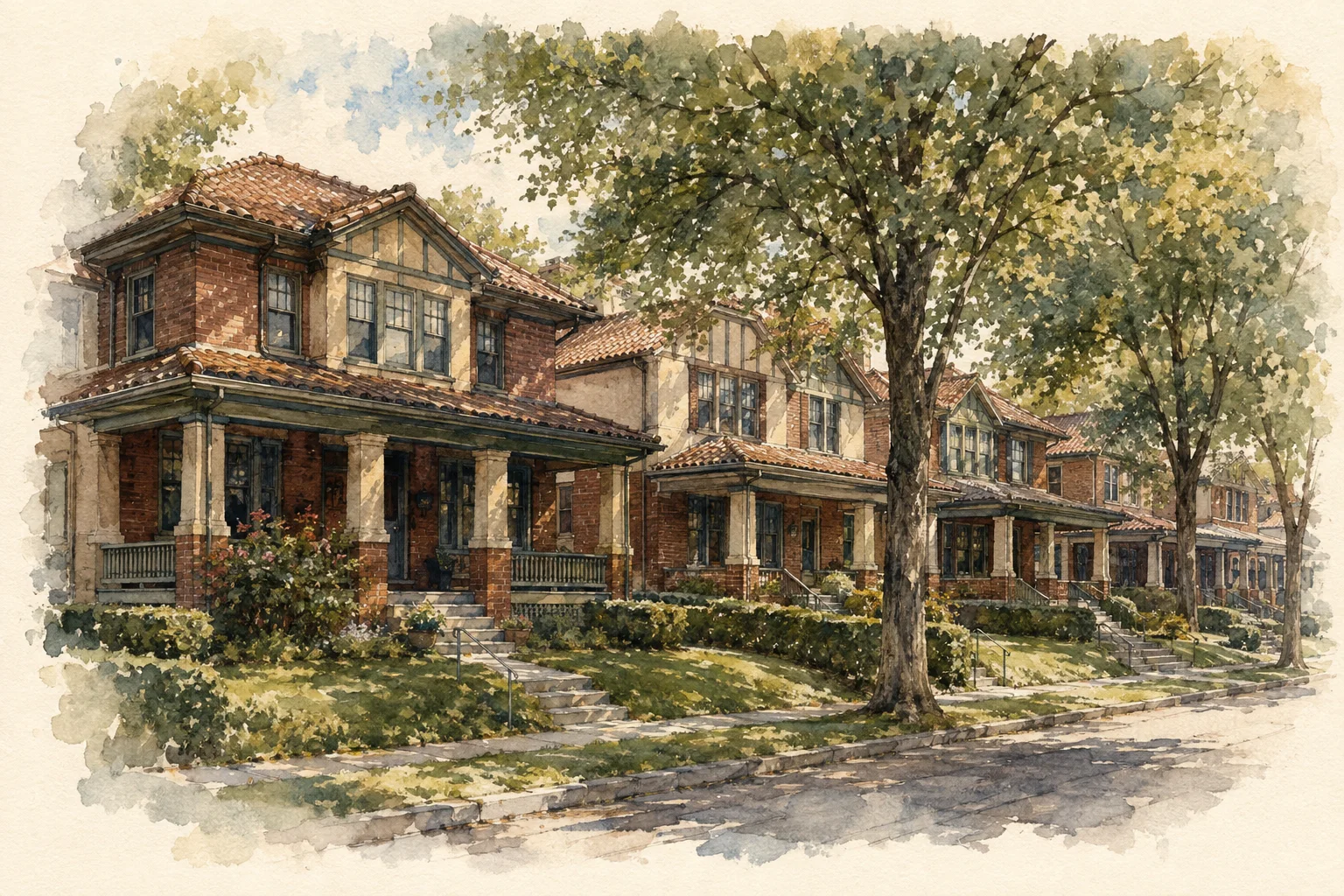
Most of South Philadelphia is defined by dense attached rowhomes packed tightly together block after block. Girard Estate breaks that pattern immediately. The neighborhood’s signature semi-detached twins create visual space that barely exists elsewhere nearby. Side yards separate homes from each other. Front porches sit farther back from the sidewalk. Some homes even have driveways or garages, which still feels unusual by South Philly standards.
Locals often call these simply “the estate houses,” as if no further explanation is necessary.
The neighborhood traces back to a planned development built between 1906 and 1916 on land formerly connected to merchant Stephen Girard’s estate. Around 481 homes were constructed under the direction of the Windrim brothers, creating one of Philadelphia’s most distinctive residential pockets. Architectural styles varied across blocks, including Prairie, Mission, Colonial Revival, and Jacobean influences that still stand out sharply against surrounding rowhouse streets.
Even residents who know little about architecture recognize that the houses feel fundamentally different from nearby neighborhoods. People regularly describe the area as looking suburban despite sitting squarely inside South Philadelphia. The semi-detached layout changes everything from parking patterns to social behavior.
Porch culture becomes especially important here. On many blocks, residents spend evenings sitting outside watching neighbors pass through the street. Conversations travel across porches and side yards naturally. Kids move between houses more freely than on tighter rowhouse blocks. During warmer months, certain streets develop predictable social rhythms where familiar faces appear outside at nearly the same times every evening.
Parking also shapes how people emotionally value the estate blocks. Driveways and garages create a kind of neighborhood envy that outsiders immediately notice. In a part of Philadelphia where parking stress dominates daily life, even a small private parking space dramatically changes how residents experience the neighborhood.
Buyers specifically hunt for homes on the strongest estate blocks because the atmosphere shifts block by block. Streets closest to Girard Park often carry the most prestige. Homes there feel quieter, greener, and more visually tied to the original planned development. Residents pay attention to those differences carefully.
Locals also romanticize the twins because they represent stability. Many families stayed in these homes for generations, especially throughout the neighborhood’s heavily Italian-American decades. Even as demographics continue changing, the houses still carry emotional weight tied to family history, neighborhood pride, and old South Philly identity.
People who live here often speak about the Estate almost like membership in a small enclave inside the city. Saying you live “in the Estate” carries more social meaning than simply naming a ZIP code. The architecture helped create that mindset over generations.
Even residents who complain about parking, taxes, or city services still describe the blocks themselves with unusual attachment. The houses are not just buildings to locals. They are the entire emotional framework of the neighborhood.
The planned estate, by the numbers
The two hard figures the guide puts on the neighborhood's origin.
The Safety Conversation Nobody Answers the Same Way
Ask locals whether Girard Estate is safe and the answer almost always comes with hesitation, qualifiers, or neighborhood-specific caveats.
People regularly describe the area as quiet, family-oriented, residential, and calmer than many surrounding sections of South Philadelphia. Then almost immediately, the conversation shifts toward reminders about block-by-block differences, city awareness, and the reality that Girard Estate still exists inside Philadelphia.
That pattern repeats constantly because locals tend to distrust simple neighborhood labels. Residents who have lived in South Philly for years rarely speak in absolutes about safety. Instead, they mentally map the neighborhood through routines, intersections, timing, and familiarity.
The core estate blocks closest to Girard Park carry the strongest reputation for calm residential life. Streets lined with twins, porches, and long-time homeowners generally feel quieter throughout the day and evening. Many residents describe those blocks as insulated from some of the chaos that spills through busier corridors nearby.
Once you move farther toward major commercial stretches or outer edges near Oregon Avenue, the atmosphere shifts gradually. Traffic increases. Noise levels change. More unfamiliar vehicles move through the area. Locals pay close attention to those differences even when outsiders see the neighborhood as one uniform section of South Philly.
Late-night activity becomes another dividing line in how residents think about safety. Areas closer to busy corridors or bar traffic can feel completely different after midnight than they do during the afternoon. People who have lived there a long time instinctively adjust routes, parking habits, and walking patterns depending on the hour.
Timing matters heavily in local safety conversations. A block that feels peaceful during weekday mornings may feel entirely different when nearby bars empty late at night or after major sports events. Residents often frame safety through movement patterns rather than crime statistics. They pay attention to who is outside, when streets become crowded, and how familiar the environment feels at certain hours.
The phrase “block by block” becomes the neighborhood’s real measuring stick. Locals use it constantly because they know conditions can change within only a few turns. Outsiders sometimes misunderstand that phrasing as evasive, but longtime residents see it as practical reality.
People who grew up in South Philly also tend to define safety differently than newcomers. Many residents evaluate a block through neighborhood familiarity, visible long-time homeowners, regular street activity, and whether neighbors actively watch the area. A busy block with people outside may feel more comfortable to locals than a quieter isolated street with less visible activity.
Girard Estate’s reputation ultimately comes from balance. Residents appreciate the calmer pace compared to trendier or denser sections of Philadelphia, but they also understand the city dynamics surrounding them. That practical mindset shapes nearly every local conversation about the neighborhood.
Parking Rules, PPA Fear, and Local Survival Tactics
Parking complaints unite Girard Estate residents faster than almost anything else.
No matter where people stand politically, socially, or generationally inside the neighborhood, parking frustration cuts across every conversation. Reddit threads, Facebook groups, local discussions, and neighborhood arguments all eventually drift back toward parking stress, ticket anxiety, construction disruptions, or stories about the Philadelphia Parking Authority.
PPA resentment operates almost like part of local culture. Residents constantly exchange warnings about ticket zones, temporary restrictions, street cleaning schedules, and areas where enforcement suddenly increases without warning. People memorize parking rules the way suburban residents memorize highway shortcuts.
Timing controls everything.
After 7 p.m., the search for parking changes completely on many blocks. Residents returning from work begin circling familiar areas hoping to find spots before neighbors settle in for the night. Game nights create another layer of stress, especially when stadium traffic starts spilling northward. Construction days can disrupt entire parking routines residents have followed for years.
Locals develop extremely specific parking instincts over time. People strategically choose spots based on when they plan to leave the next morning, which direction they expect traffic to move, and whether upcoming construction or street cleaning might create problems overnight.
Some residents intentionally park farther away during easier hours to avoid impossible searches later at night. Others guard certain parking habits almost like neighborhood secrets. Longtime locals quietly know which blocks clear out early in the morning, which corners attract enforcement attention, and where overnight parking becomes risky.
Street cleaning patterns become part of residents’ weekly mental calendars. Missing one sign or forgetting one timing rule can ruin an entire morning. Locals frequently remind newcomers to read every temporary notice carefully because enforcement appears inconsistent until suddenly it is not.
Construction projects create another recurring frustration. Residents often complain about streets getting torn up repeatedly while parking availability shrinks block by block. Detours, cones, temporary no-parking zones, and utility work can destabilize parking routines for weeks at a time.
Sports traffic also changes neighborhood behavior in subtle ways. During major games or stadium events, locals sometimes avoid moving their cars entirely once they secure a decent spot. Residents living closer to heavier traffic corridors learn to anticipate spillover patterns before outsiders even notice them.
Parking knowledge eventually becomes a form of neighborhood credibility. Longtime residents can often explain which blocks become impossible after certain hours, where ticket enforcement quietly concentrates, and which parking mistakes immediately identify someone as unfamiliar with the area.
People who adapt successfully usually stop thinking about parking as a simple inconvenience and start treating it like a daily logistical system tied to timing, weather, events, construction, and neighborhood rhythm.
The Neighborhood Change Everyone Notices
Nearly every long conversation about Girard Estate eventually turns toward change.
Older residents remember the neighborhood as heavily Italian-American, deeply family-oriented, and socially tight-knit in ways that shaped daily life block by block. Many families stayed in the area for generations, and neighbors often knew each other’s relatives, routines, and histories automatically.
That legacy still influences the neighborhood strongly today, even as demographics continue shifting.
Younger buyers have increasingly moved into Girard Estate because of the housing stock, quieter atmosphere, and relative space compared to denser parts of South Philadelphia. The estate houses attract people specifically looking for porches, side yards, larger interiors, and calmer residential blocks without leaving the city entirely.
Many newer residents appreciate exactly the qualities longtime homeowners spent decades preserving. They value the slower pace, strong neighborhood identity, and visible community structure that still exists around the park and estate blocks.
At the same time, generational turnover creates underlying tension that surfaces in conversations about development, neighborhood identity, and how the area should evolve.
Older residents sometimes describe the neighborhood as more cohesive in previous decades, especially when discussing childhood memories, block culture, or earlier eras when nearly every house contained long-established South Philly families. Newer arrivals often hear these stories alongside subtle anxiety about losing neighborhood character.
Development debates reveal those tensions clearly. Residents frequently push back against projects they believe could “cheapen” the neighborhood atmosphere or weaken the distinct feel separating Girard Estate from surrounding areas. Concerns about overdevelopment, traffic, parking pressure, and architectural mismatch appear regularly in civic discussions.
The Oregon plaza conversations became one of the clearest examples of this divide. Some residents appreciated the added convenience and commercial access. Others worried that larger retail development would erode the quieter residential character defining the neighborhood historically.
Naming debates also connect directly to identity preservation. Many locals strongly resist labels they associate with aggressive real estate marketing or neighborhood rebranding. Residents who feel protective of Girard Estate often see those naming shifts as attempts to erase local history for marketability.
Civic organizations play a major role in these conversations. Groups connected to the park, zoning issues, and neighborhood preservation often become gathering points for residents trying to shape how Girard Estate changes moving forward.
Most of the tension stays relatively quiet on the surface. The neighborhood does not carry the same openly combative energy seen in some rapidly gentrifying sections of Philadelphia. Still, the generational divide remains visible in how residents talk about development, neighborhood boundaries, commercial projects, and what kind of place Girard Estate should remain over the next decade.
Underneath nearly every conversation sits the same concern: preserving the parts of the neighborhood that make it feel different from everywhere surrounding it.