A little orientation
Choose one Logan Square cultural anchor
Book the main visit first
Check the museum's current admission and visit arrangements before filling the rest of the day.
Choose for your group
Compare the experience and access information with the interests, ages, and pace of the people coming.
Plan both journeys
Use the actual museum entrance and your expected finishing time when planning transit.
A closer look
What would make the day worthwhile?
Choose a cultural anchor, then check the practical details before adding more stops.
Build around one museum visit
Open the Franklin Institute's own visitor information and identify the admission or experience that interests your group. Check what that choice includes, then ask any access questions before setting the rest of your Logan Square schedule around it.
A useful questionWhat is included in the visit our group wants?
Source & next step ↗Leave room for the collection
Use the Barnes Foundation's own site to choose the collection visit, exhibition, or program you want to explore. Check admission and access arrangements, then give that visit enough space in the day before adding another Parkway stop or a meal.
A useful questionHow much of the day do we want to give this visit?
Source & next step ↗Plan around the actual entrance
Enter the chosen museum and your starting point into SEPTA's planner, then confirm the entrance through the museum's own information. Compare the trip home at your expected finishing time, including a shorter option if your group wants to leave early.
A useful questionHow would we get home if we finish earlier?
Source & next step ↗Between frog spit, flashbulbs, and the city's loudest quiet
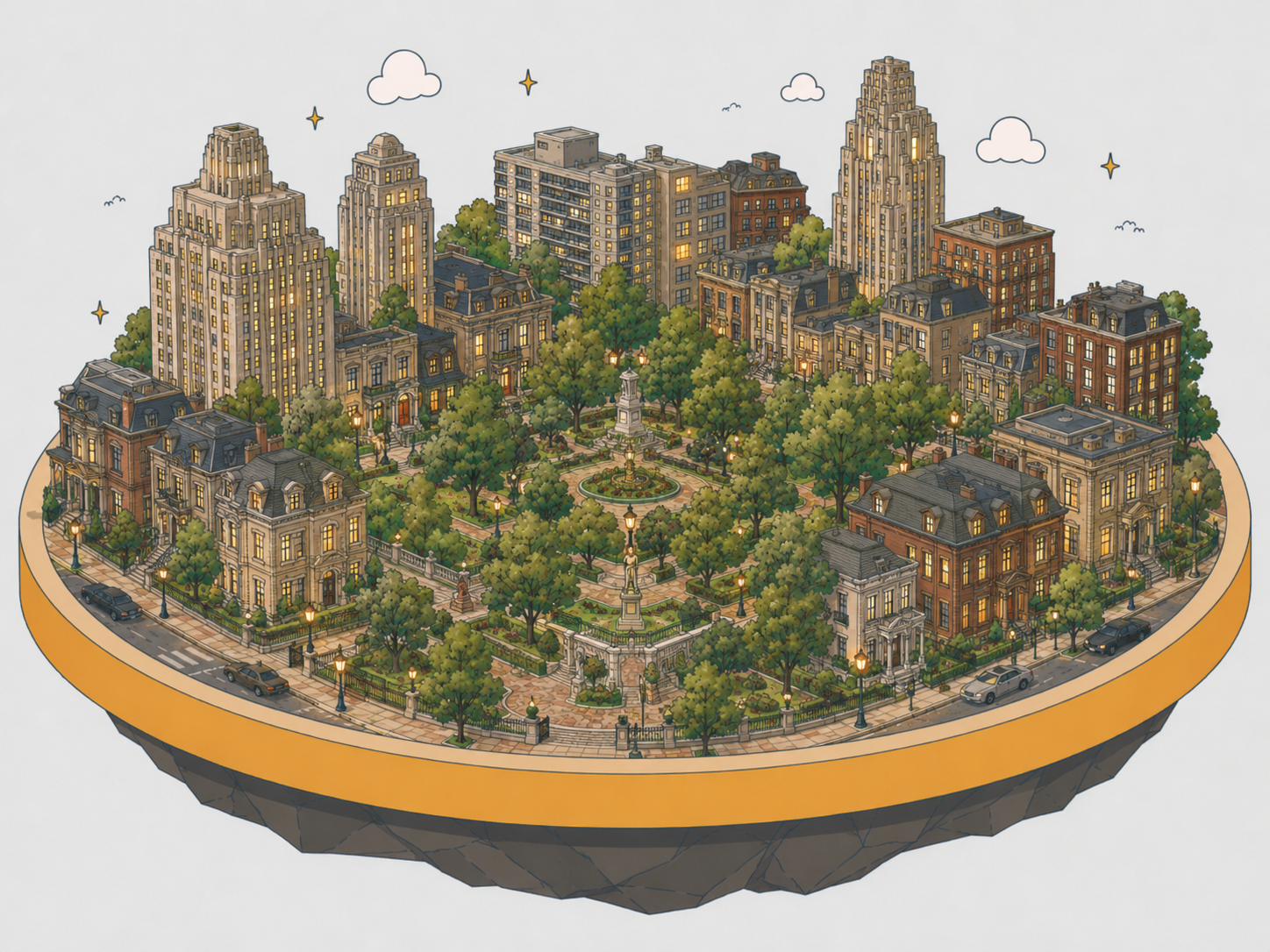
Logan Square is luxury condos looking down at the Parkway and long-standing brownstones tucked beside the cathedral. This isn't a neighborhood you understand until you've lived its rhythms. The same fountain that draws influencers at sunset is a local sanctuary at dawn, and the street that feels serene on Tuesday morning can sound like a parade on Friday night.
The circle that defines the city
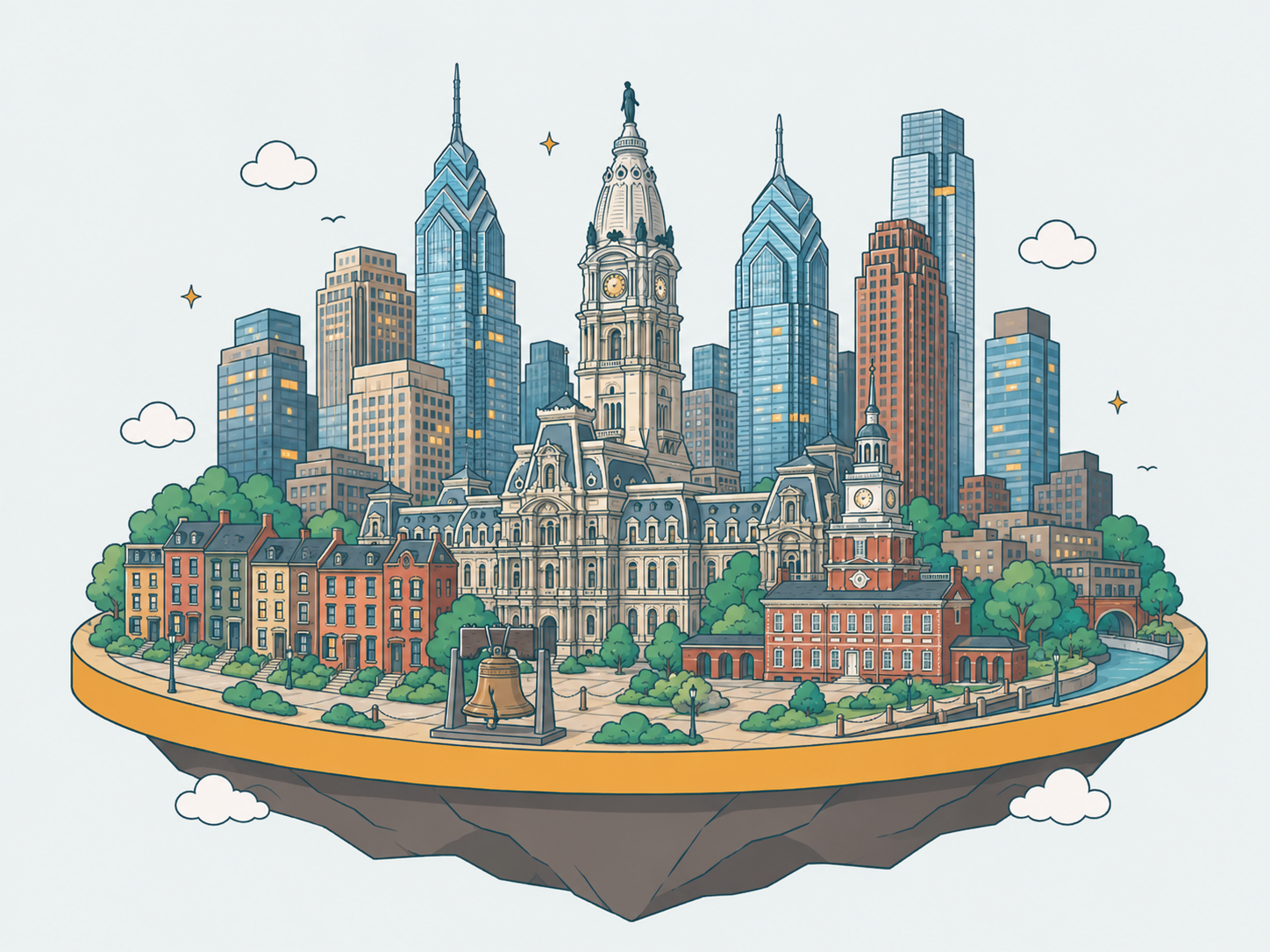
Logan Square doesn't just sit at the center of Philadelphia's map — it's the city's visual thesis statement. The skyline fans out around a circle that isn't quite a circle, defined by water, bronze, and a loop of traffic that never really stops. What William Penn laid out as one of his five public squares became something more layered: a crossroads of beauty and frustration where museum flags ripple above delivery trucks.
Stand on the wrong corner and it reads as chaos. Step onto the fountain's inner ring at six in the morning and you see the geometry the way locals do — symmetrical, ordered, quiet before the day unravels. Every building around the square carries the same contradiction: the cathedral glowing against modern glass towers, the Franklin Institute humming with field trips, the air switching between civic pride and commuter impatience.
Living here means learning to read that rhythm. The traffic-light sequence becomes a metronome. The fountains, off all winter, mark the emotional calendar of the year. Even the street cleaners circling before sunrise feel like choreography. It isn't calm — it's precise. Once you've memorized the loop, you understand why locals defend it.
The birdbath at the center of everything
Every Philadelphian knows the fountain before they know its name. Officially it's the Swann Memorial Fountain. Everyone calls it the birdbath, or just "the circle." During heatwaves the city posts "no swimming" signs that nobody obeys — kids run straight through the spray while photographers line up for the reflection shot that lands between six and seven in the evening, when the skyline looks like it's rising out of the water.
The day has a schedule. Mornings belong to dog-walkers and joggers cutting across to the Parkway. Midday fills with families and strollers circling the turtles and frogs. Late afternoon turns into performance — slow-motion spins, couples pretending not to notice the crowd watching them pose. Locals know when to step back, and they know the angles: the best photos aren't from the front, they're from behind the swans, where the traffic noise fades and the mist catches the sunset.
The fountain shuts down after October, but the space never loses its pull. People still walk the perimeter out of muscle memory, pausing at the same benches they used all summer. Nobody calls it peaceful. Everybody calls it theirs.
Inside the Parkway bubble
Locals half-jokingly call this corridor the Parkway Bubble — dense enough with art, architecture, and civic landmarks that it feels separate from the rest of the city. A few distinct pockets sit inside the walk.
The Circle
Swann Memorial FountainThe core, and the reason the street grid bends. Wedding shoots, tourist selfies, and childhood summers collide here. On at sunrise, drained after October, and never entirely quiet.
The Museum Run
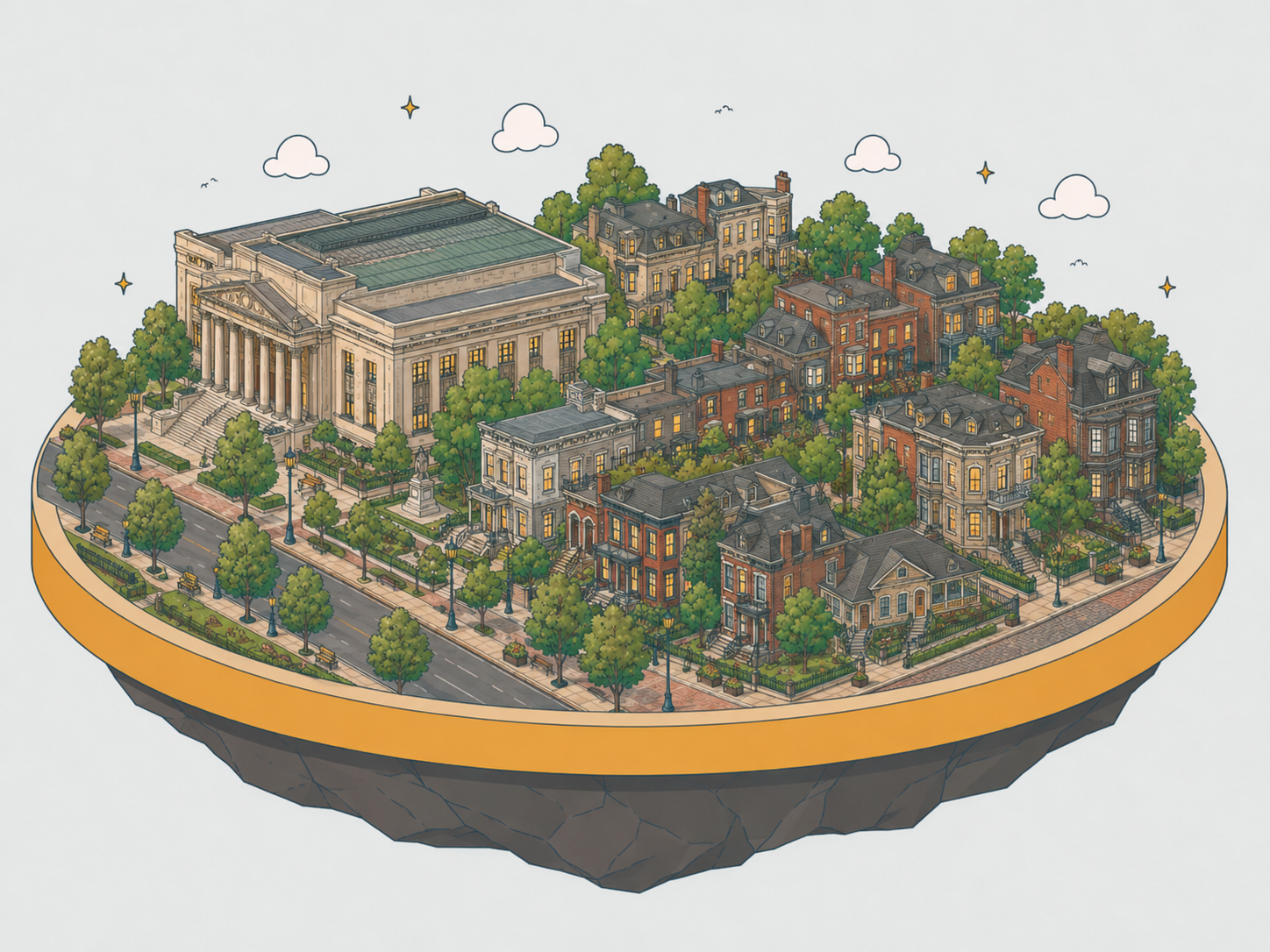
Along the ParkwayThe Franklin Institute's domed silhouette on one side, the Barnes Foundation in quiet modernism on the other, the Rodin just beyond. Residents treat museum steps as shortcut stairs on the way to an appointment.
The Cathedral Basilica
East side of the circleLimestone against glass towers, and bells that quietly tell the neighborhood what time it is. Parents steer strollers past it like any other landmark on the way to the playground.
Sister Cities Park
Off the circle · family sideCurated for childhood — a miniature boat pond in summer, shallow fountains kids wade into, café tables where parents nurse half-finished coffee. On a warm afternoon it's a splash zone, and white shirts are a mistake.
Koz Park
A few blocks overNo postcard appeal, but lived-in — the same faces week after week, a playground that hums, a basketball court that fills by late afternoon, and a block that smells faintly of barbecue by dusk.
Aviator Park
Shaded cut-throughThe shortcut locals use to skip the crowds, with a bench line that faces west for late-afternoon light. A short loop from here connects LOVE and AMOR without crossing the bad intersections.
Spring Garden & the tunnels
North edgeWhere the tone changes: construction thud, traffic hiss, and past the Race Street tunnel the foot traffic thins out fast. The bubble has an edge, and this is it.
What the bubble gives you — and what it doesn't
- The Franklin Institute, the Barnes, and the Rodin inside a short walk.
- Trader Joe's and Whole Foods reachable on foot for a normal grocery run.
- Sister Cities Park's boat pond and shallow fountains for kids in summer.
- A basketball court and a real playground at Koz Park.
- A LOVE-to-AMOR loop that skips the dangerous crossings.
- A skyline you can see from the street, the fountain, and the bridge coming home.
- Parking that doesn't cost you a ticket eventually. The PPA patrols constantly.
- A weekend with the fountain to yourself — that's a weekday sunrise, briefly.
- Streets that stay open through marathon, festival, and fireworks season.
- Total quiet. There's only familiar noise, at every hour.
- Advance warning from the city — the flyers taped to poles matter more.
Where locals eat, sip, and grumble
Dining here is a study in contrast — every polished plate comes with a complaint, and every view with a bill that's a little proud of itself.
Urban Farmer
$$$The neighborhood's unofficial living room, where power lunches and anniversary dinners share the same tables. Not the cheapest meal in the city, but locals return for the steak and the ritual of watching the fountain glow through the wide glass.
Best for · the occasion dinner
The Logan rooftop
$$$$A few steps up from Urban Farmer, and it trades quiet for spectacle. On summer evenings every seat becomes a stage for skyline photos and every cocktail doubles as an admission ticket to the view. Go knowing that's the deal.
Best for · the view, honestly
La Colombe
$$$$The weekday pilgrimage for anyone who knows better. It's a few blocks east — under ten minutes on foot — and the detour buys you an escape from the tourist current along with the coffee.
Best for · the morning walk
Logan Square Café
$$$$It looks inviting from the outside and sits in the perfect spot, but residents report the coffee is inconsistent enough that most quietly walk the extra ten minutes east instead. Location isn't everything.
Best for · convenience over coffee
Trader Joe's & Whole Foods
The two grocery runs that make the no-car life work. Between them, coffee near Comcast, and dinner within the bubble, you can go weeks here without starting an engine.
Best for · living without a car
Reality check: what keeps dining here interesting isn't only what's on the menu — it's how locals use it. They time meals around event traffic, pick restaurants for their exit routes, and sometimes carry takeout past joggers and camera crews because eating outside during peak hours is a losing proposition. Logan Square feeds its residents well. It just makes them earn it.
The culture is the neighborhood
Visitors treat these as destinations. Residents route errands through them.
The Franklin Institute
The domed silhouette that commands this stretch of skyline, and the reliable source of field-trip noise on a weekday morning. If you live here, it's a landmark you navigate by, not a day out.
Best for · kids, and orientation
The Barnes Foundation
Quiet modernism a short walk from the circle, with walls that glow at sunset. The calmest of the Parkway institutions from the outside, which is most of how residents experience it.
Best for · an unhurried afternoon
The Rodin Museum
Just beyond the Barnes, adding another layer of history to a corridor where nearly every block already feels curated.
Best for · a short detour
Cathedral Basilica
Limestone glowing against modern glass, and church bells that residents come to rely on subconsciously for the time. The steps double as a shortcut for anyone running late.
Best for · the bells, if nothing else
LOVE & AMOR
The two sculptures, connected by a short local loop that avoids the worst intersections. Not a secret exactly — but the route feels earned once you know it.
Best for · a walk with a destination
The Parkway Library
The soundscape shifts with the schedule here — brass music from a festival on the lawn one weekend, ordinary library quiet the next.
Best for · an ordinary weekday
A neighborhood that lives by the clock
Logan Square runs on its own time. The difference between living here and visiting is knowing that what you see at ten in the morning has almost nothing in common with what you'll see at dusk. Timing decides everything — how long it takes to cross the Parkway, how quiet the fountain feels, how patient you'll be by the end of the day.
Early mornings are softer than a spot this central has any right to be: street cleaners humming, joggers appearing like clockwork, the square almost cinematic in its emptiness. By midday, delivery vans crowd the curbs and the sidewalks pulse with commuters. Evenings split in two — weekdays bring calm anticipation and the fountain's mist glowing under the skyline, while weekends fill the same hours with noise and flashbulbs.
Tuesday mornings have a quiet cult following. The light still hits, the tripods haven't arrived, and the neighborhood exhales after Monday. That calm is gone by Thursday night. Living here means adjusting to the tempo rather than fighting it — there's no real off-hour, only quieter ones you learn to guard.
Getting around (leave the car)
Owning a car in Logan Square is like owning a pet you can't leave alone. Between street sweeping, rotating closures, and the ever-present PPA patrol, parking is a competitive sport nobody wins. Residents talk about "surviving without tickets" the way suburbanites talk about mortgage rates, and they aren't exaggerating.
So people adapt. Most longtime locals walk everywhere, half by choice and half by necessity. Groceries are a short stroll to Trader Joe's or Whole Foods, coffee is La Colombe near Comcast, and date nights happen entirely on foot. You can go weeks without starting an engine — leave your door and be almost anywhere in twenty minutes.
If you do keep a car
- Learn the garages — which ones lower their gates late is local folklore, passed between neighbors.
- Learn the PPA rhythm — the hours it slows down before shift change are part of the same folklore.
- Never assume overnight is safe near the Parkway. Tickets arrive faster than coffee deliveries.
The walking payoff: shade behind Aviator Park, past the cathedral stairs, crossings timed to the split second before the light turns. It's all muscle memory after a while — and every ticket avoided starts to feel like a small win.
Between marathons and cranes
Spend enough time here and you start organizing your life around closures. Streets vanish overnight under barricades and orange cones. Marathon season arrives like weather — predictable, unstoppable. By Friday, residents are scanning poles for flyers warning of "temporary restrictions." By Saturday, the Parkway is a running track or a festival ground and the neighborhood is a maze of blocked intersections and idling cars that can't escape.
Most locals love and resent it simultaneously. There's pride in watching the city come alive for parades, concerts, and fireworks, and real frustration in being trapped by it. Deliveries reroute for miles; simple errands become strategic missions. Some residents rent out their parking spots to event-goers, a small summer economy. Others just walk until the barricades come down.
Then there are the cranes. They arrive before sunrise for construction picks and close lanes while you're still asleep — you hear the beeping before you open the blinds. It isn't neglect, it's the price of constant reinvention: the skyline that looks timeless from the fountain is always changing. The calendar may say July or October, but residents think in events. Fireworks, marathons, and roadwork are the unofficial seasons of Logan Square.
Rent, status, and the balcony cat
Few Philadelphia neighborhoods talk about cost of living this specifically. The numbers here aren't abstract — they're measured in steps from the fountain. Rent climbs the closer you get to the view. The luxury towers offer skyline balconies and concierge desks; older brownstones hold onto charm and slightly lower prices. A one-bedroom runs from expensive to astonishing, and the waitlists stay full anyway.
The building that draws the most curiosity is 2100 Hamilton, a glass-and-steel statement piece looking straight down at the circle. From the street you can see a small balcony where a cat sits most afternoons beside a flag — a neighborhood talking point that people photograph like a landmark, half-admiring, half-joking about what that cat's rent must be.
For residents living in the shadow of those towers, luxury feels close and distant at once — visible through the trees, reflected in the fountain, rarely attainable without compromise. What anchors people isn't prestige. It's living at the city's crossroads, where beauty and frustration coexist and every rent check buys proximity to something undeniably alive.
An honest note on numbers: we don't publish rent or purchase figures we can't stand behind. What we can tell you exactly is our own price — a standard reset starts at $170, all-in.
Is Logan Square for you?
It's the center of the city, with everything that implies in both directions.
- You'd rather walk everywhere than keep a car alive here.
- You want museums, a cathedral, and a skyline as your daily backdrop.
- You have kids and you'd use Sister Cities Park or Koz Park weekly.
- You like a neighborhood that shows up for its own Saturday cleanup.
- You can hold two truths: it isn't perfect, and you don't need it to be.
- You need a reliable, ticket-free place to park a car.
- You want quiet — there's no such thing as total silence here.
- Event closures and construction detours would wear you down.
- You'd resent tripods, drones, and photo shoots on your block.
- You want a neighborhood that isn't also a destination.
Nights, noise, and negotiated safety
After dark, Logan Square changes personality. The paths that feel open and breezy by day take on a compressed, echoing stillness once the lights come on — office buildings dim, fountains glow blue, and passing cars fill every gap in conversation. Nights here aren't dangerous by default, but they ask for alertness. Residents pick their routes instinctively, and the difference between a peaceful evening and a tense one is usually timing and direction.
The Parkway itself stays active long after midnight, a corridor of headlights running toward the Art Museum. Step too far north toward the tunnels and the tone shifts: the foot traffic thins and the comfort that exists near the fountain fades. Most locals carry their own internal safety map, drawn by experience rather than fear.
What locals actually do
- Avoid the Race Street tunnel late at night. It isn't about fear — it's knowing where quiet turns into isolation.
- Look before stepping into the crosswalk, even on green. Traffic here behaves on its own terms.
- Stay in step with the routine — recognize faces, keep to lit routes, and treat pattern recognition as the tool it is.
There's also an informal watchfulness. People notice who parks where and who walks the same route daily. Someone leaves a note when a package sits too long in a lobby; someone else texts the local association about what they saw near the Parkway. Local groups and neighborhood threads act as real-time alert systems, blending civic pride with the occasional bit of gossip. The neighborhood rarely feels anonymous, because everyone participates in keeping its order.
The unofficial seasons
Residents here don't think in months. They think in fireworks, marathons, and roadwork.
The fountain restarts
The fountain sputters back to life, tulips appear along the Parkway, and people rediscover their patience for crowds. Weekday mornings smell like wet stone and fresh mulch. For a few weeks everyone lingers.
Fireworks on the Parkway
Fireworks, festivals, and the kind of gridlock that tests even devoted residents. There's pride in surviving it and genuine exhaustion afterward. By August, locals have perfected slipping out early and staying in until dusk.
Marathon season
The crowds come back and the Parkway turns into a running track for the weekend. The air is lighter and cooler, the skyline looks crisper — and half the intersections are closed.
The neighborhood cleanup
Long before the crowds return, neighbors gather with gloves and trash bags under the local civic association's banner. Coffee from nearby cafés, brief greetings, then curbs swept and last weekend's debris bagged. Done by ten.
The fountain drains
Benches empty and the wind whips down the Parkway. Then the first snow falls, the streets glow under lamplight, and for a few short weeks the neighborhood feels almost private.
The unwritten rulebook
Every long-term resident learns the rules nobody writes down — survival habits disguised as common sense.
- Never assume your car is safe overnight near the Parkway. Everyone here has a story about that bright orange envelope.
- Go early or not at all. Saturdays belong to tourists, photographers, and wedding parties. If you want the fountain to yourself, aim for sunrise on a weekday and keep it brief.
- Read the poles, not the website. The city won't warn you about closures; flyers taped to poles often matter more than anything official. Locals plan grocery runs and reservations around them.
- Avoid the Race Street tunnel late at night. Not fear — timing.
- Look before you step off the curb, even on a green light.
None of it is meant to scare newcomers. It's how people coexist with the neighborhood's rhythm instead of fighting it. Follow the rules without thinking and you've become part of the place.
A Logan Square home, season by season
What each season does to a home on the Parkway — and the move that answers it.
The fountain restarts, the tulips come in along the Parkway, and every window in the place gets opened for the first time in months — onto a corridor of traffic and mulch dust.
The move · A full window-and-sill pass while the light matters most, plus a reset of every horizontal surface the winter left behind.
The air turns thick with exhaust and sunscreen, event weekends track grit through lobbies and entryways, and balcony doors stay open over an idling street.
The move · Frequent dusting of sills, glass, and balcony thresholds, with a light, dry pass that doesn't add moisture to an already-heavy week.
Marathon season brings crowds and closures, the crews and cranes keep working, and the first heating cycles push a summer's worth of dust through the whole home.
The move · Vents, baseboards, and glass in one pass, booked for a weekend the street closures actually let us park.
The fountain drains, the wind runs straight down the Parkway, and salt comes in at every lobby door and stoop while dry building heat bakes dust onto every surface.
The move · Lobby-to-door floors every visit, and glass kept clear — the Parkway wind means sills and balcony doors take the brunt of winter here, not the floors.
Keeping a Logan Square home effortless
Two kinds of home sit inside a few blocks of each other here: luxury condos overlooking the Parkway, and long-standing brownstones tucked beside the cathedral. They need different things, and both need consistency more than heroics.
What these homes need
- Glass, and a lot of it — the skyline view is what you're paying for. Balcony doors and tall windows are the first thing to show a week of Parkway air.
- Building access, handled up front — concierge desks, elevators, and COI paperwork are normal here. Flag it at booking and it's a non-event.
- Construction dust — the cranes are permanent scenery, and the fine grit they throw settles on sills and hard surfaces faster than most people expect.
- The entry — event weekends, cleanup Saturdays, and winter salt all arrive at the door. It's where a routine visit does the most work.
Why trust this guide? Nothing on this page was paid for. It covers both sides of the Parkway — the condo towers with the concierge desks and the brownstones behind the cathedral — which are the same neighborhood on paper and two different places to live.
Make it yours
Before your Logan Square day
A short list to turn what you read into your own next steps.
Saved checks stay on this device when browser storage is available. This is a personal planning list, not a property inspection or professional assessment.
A few good questions
Before you make a plan.
How much does house cleaning cost in Logan Square?
Do you clean the Parkway high-rises and doorman buildings?
What happens if my street is closed for a marathon or a festival?
Do your cleaners need a parking spot?
Do cleaners bring their own supplies?
Can I get the same cleaner each visit?
Sources & next steps
Useful advice should
show its working.
These resources support the reader tools above and help you check details for your own address, date, or plans.
- The Franklin Institute
Museum information and ticket links let you check the visit you intend to book.
- The Barnes Foundation
The museum's own site provides visit planning, exhibitions, and booking information.
- SEPTA trip planner
Compare transit journeys using your actual stops, date, and departure time.
Operator links help you check the visit you intend to make. The tool does not assume particular exhibits, free entry, or parking arrangements are available.
Keep exploring